Education and crypto-shopping: A remarkable correlation revealed
Crypto-shopping is a buzzword capturing the collision between cutting-edge blockchain technology and the dynamic world of e-commerce. As digital transactions evolve, this realm of crypto-fuelled shopping is drawing increasing attention. Yet, who exactly are the trailblazers navigating this new landscape? While the very-detailed answers were presented in the full version of the Cryptorefills Labs’ 2022 report, here we provide a snapshot, revealing that education plays a surprisingly prominent role in crypto-shopping trends. Interestingly, data suggests that these pioneers tend to be more educated than the average global citizen.
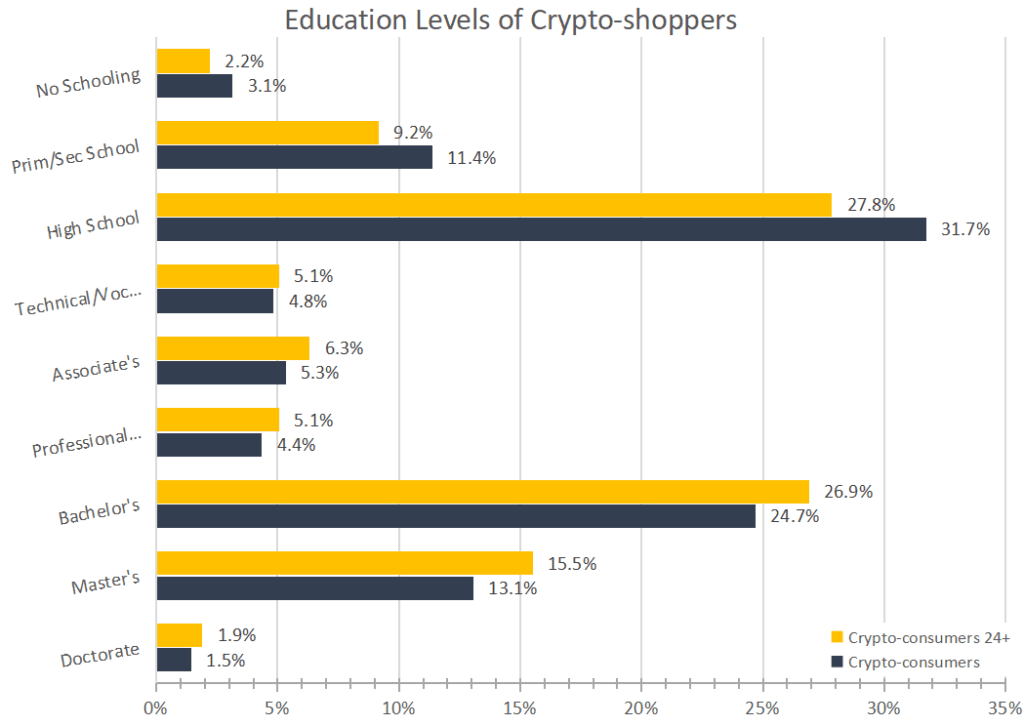
As of 2022, high school is the single most common education level among crypto-consumers, at 31.7%. What stands out is the tail above it: the share holding a bachelor’s degree or higher is far larger than in the adult population at large, which suggests higher education plays a real role in enabling participation in crypto-shopping. The chart presents a breakdown of the education levels of all crypto-shoppers and those at least 24 years old. We see in the chart that more than a quarter of crypto-consumers aged 24 or older hold a bachelor’s degree, more than 15% hold a master’s degree, and nearly 2% hold a doctorate, which sums up to a whopping 44%, meaning that almost half of the crypto-consumers attended university at least for four years. Yet, including the ones with a shorter higher education (i.e., having an associate’s degree or professional degree), this ratio reaches 55%.
Education levels of crypto-shoppers: all respondents, and those aged 24 or over.
But why is there such a correlation? First, using crypto for transactions necessitates familiarity with certain computer and internet skills, often cultivated through higher education. Language proficiency, particularly in English, is crucial in this global digital market. Additionally, those with advanced degrees are more likely to be exposed to blockchain-related projects in their professional or academic pursuits. Such exposure can encourage them to integrate crypto-shopping into their everyday lives. Finally, higher education levels generally correspond to lower unemployment rates across the globe, meaning these individuals may have more resources to delve into the world of crypto-shopping.
Of course, these statistics don’t mean crypto-shopping is only for the highly educated. But they indicate a noteworthy trend: Education can be a valuable key, unlocking doors to understanding and participating in this innovative form of commerce. Furthermore, it’s important to highlight the changing demographics as we look at older age brackets. Among adults 24 years or older, the proportion of those with no schooling drops to 2.2% from 3.1%, and primary/secondary school as the highest level drops to 9.2% from 11.4%. In this group, the percentage of individuals holding degrees higher than a high school diploma also increases. This points to a promising future for crypto-shopping as an increasingly educated population comes of age.
In conclusion, crypto-shopping isn’t an abstract or distant concept; it’s a growing reality. As education levels rise, so does engagement with this exciting new mode of e-commerce. By fostering digital literacy, computer skills and exposure to blockchain, education has the power to shape the future of crypto-shopping. The future looks bright but firmly grounded in the here and now. Embracing the role of education in this sphere can only accelerate our journey into this promising new frontier.
Stay crypto-tuned.