Deciphering the crypto-shopper: introduction to our research paper

In the ever-evolving landscape of digital finance, cryptocurrencies have emerged as a transformative force, reshaping not just investment strategies but also consumer spending habits. The groundbreaking study “Deciphering the Crypto-shopper: Knowledge and Preferences of Consumers Using Cryptocurrencies for Purchases” study authored by Massimiliano Silenzi, Ph.D. and Umut Can Çabuk, Ph.D. provides a comprehensive analysis of this emerging phenomenon. This research, involving a detailed survey of 516 participants, delves into the knowledge, expertise and purchasing patterns of individuals using cryptocurrencies for shopping, offering unique insights into the behaviour of crypto-shoppers.
This article emphasises the business implications of these findings. It distils complex data into simpler terms and provides pragmatic insights into how businesses can adapt and thrive in this new era of digital finance. Business owners, marketers and anyone curious about where crypto meets consumer behaviour should find something useful here.
The full research paper is available as a preprint on arXiv. Download report
Study overview
The study’s primary objective was to uncover the levels of knowledge and expertise among crypto-shoppers and how these factors influence their purchasing behaviours. The research methodology included a meticulously designed survey, followed by a sophisticated analysis comprising descriptive statistics, correlation and regression analyses and K-means cluster analysis.
Survey design and data collection
The survey, part of the 2023 Cryptorefills Labs report, was conducted from June 1st to September 9th, 2023. It targeted Cryptorefills customers who had completed at least one purchase, thereby confirming their status as authentic crypto-shoppers. The survey comprised 145 multiple-choice questions, focusing on respondents’ behaviours, demographics, perceptions, experiences and cryptocurrency familiarity. Notably, 17 questions specifically addressed knowledge and expertise, using a 5-point Likert scale.
Key findings
Varied knowledge levels among participants
One of the study’s striking revelations was the broad spectrum of knowledge levels among respondents. While a notable proportion exhibited a fundamental understanding of cryptocurrencies, there was considerable variation in expertise levels, especially concerning more specialised domains like the Lightning Network, Non-Fungible Tokens (NFTs) and Decentralised Autonomous Organisations (DAOs).
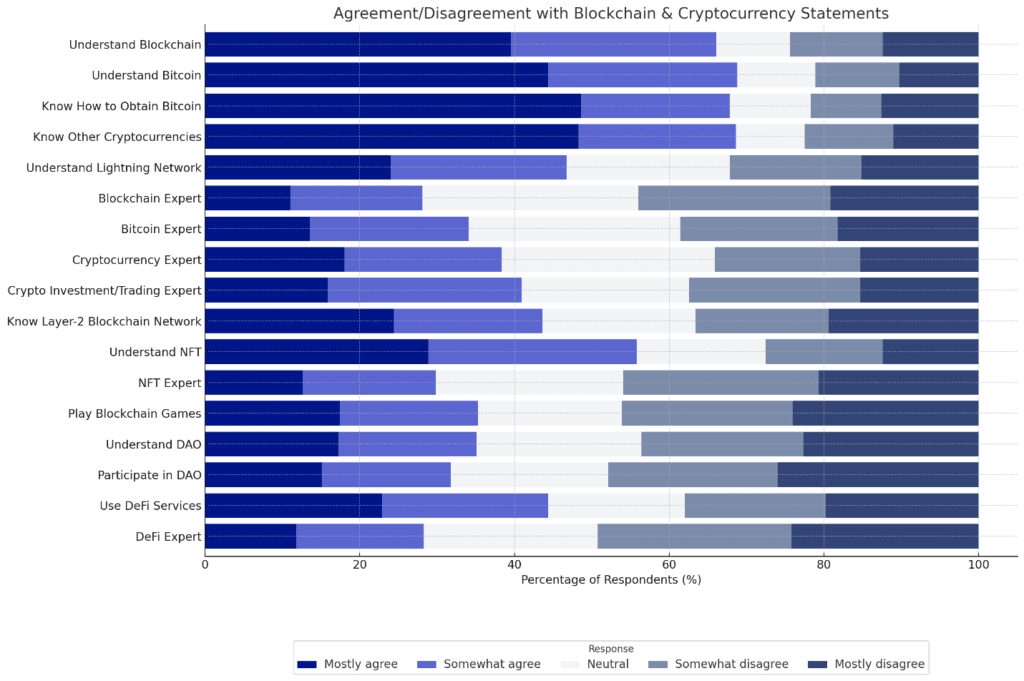
Figure 1. Distribution of responses on blockchain and crypto expertise.
High purchase frequency despite limited knowledge
Contrary to conventional expectations, about 30% of respondents demonstrated high purchase frequency even with limited cryptocurrency knowledge. This suggests that factors other than just domain knowledge might be influencing purchasing behaviour.
Descriptive statistics
The descriptive statistics provided a detailed overview of the respondents’ knowledge and expertise levels. For instance, the average rating for understanding blockchain and Bitcoin was 3.69 and 3.82, respectively. However, self-perceived expertise in these areas hovered around a score of 3, indicating a gap between general knowledge and specialised expertise.
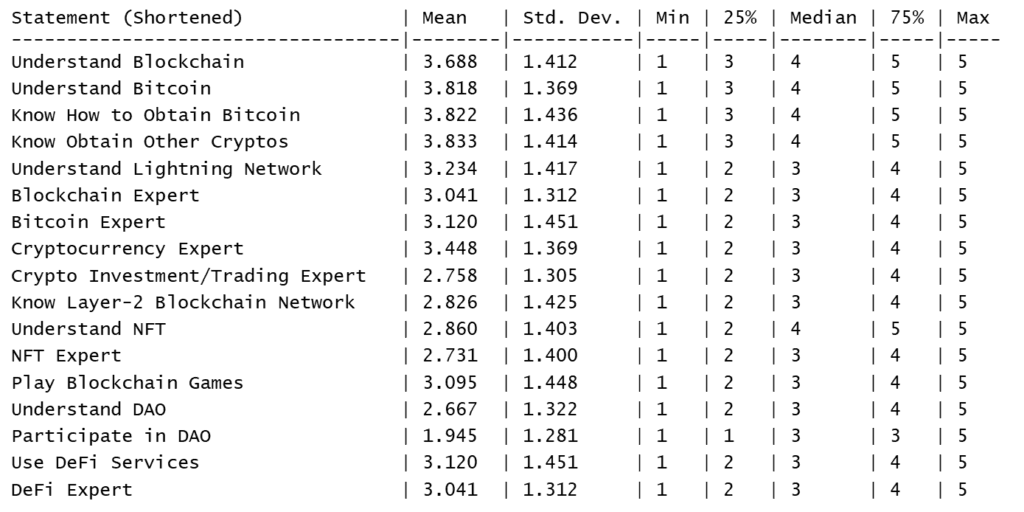
Table 1. Descriptive statistics.
Visual analysis and figures
The study used visual tools such as bar charts, scatter plots and radar plots to articulate findings. For example, Figure 1 in the study illustrates the stacked distribution of responses on blockchain and cryptocurrency expertise, offering a visual representation of the respondents’ self-assessed knowledge levels.
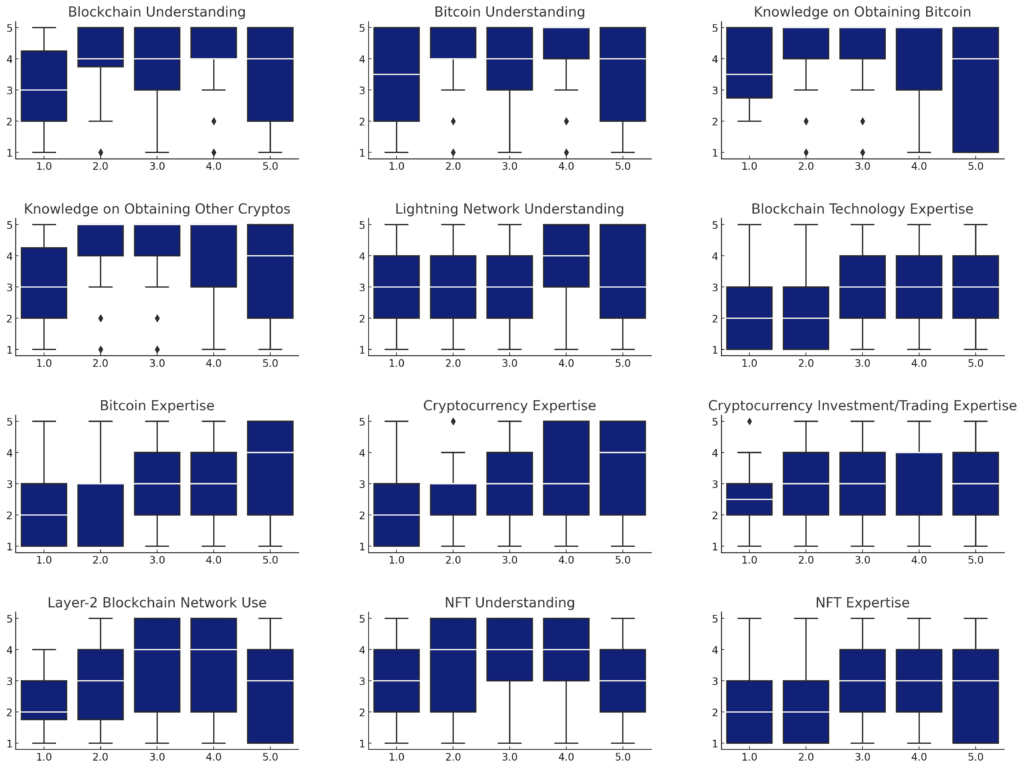
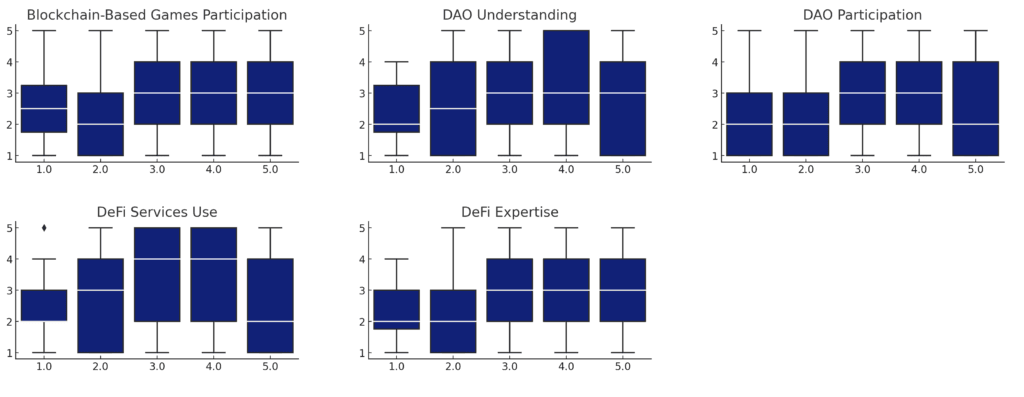
Figure 2. Box plot analysis of purchase frequency against different aspects of blockchain and crypto knowledge.
Correlation and regression analysis
The correlation analysis revealed negative correlations between purchase frequency and all knowledge variables, with “Knowledge on Obtaining Bitcoin” showing the strongest negative correlation at -0.11. This implies that increased knowledge or expertise in specific areas might correlate with a decrement in purchase frequency. The regression model, detailed in the paper, explained approximately 11.63% of the variance in purchase frequency, suggesting that other factors play a significant role in determining purchasing behaviour.

Figure 3. Correlation matrix and heatmap of the 17 knowledge variables and purchase frequency.
Cluster analysis
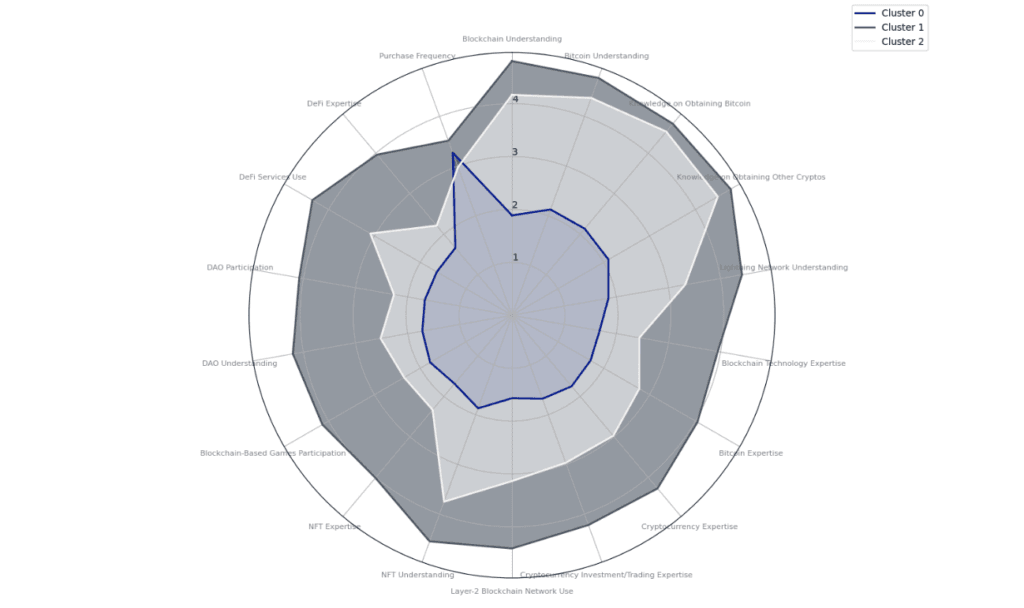
Using the K-means clustering technique, the study segmented the respondents into three distinct groups:
- Cluster 0, the low-knowledge group (28.09% of the population): displayed minimal knowledge, with foundational constructs like blockchain and Bitcoin averaging between 1.8 and 2.1. Despite their limited knowledge, their purchasing frequency was substantial, approximating 3.27.
- \1
- \1
Figure 4. Radar map of knowledge, expertise and purchase frequency by crypto-shopper.
Stay crypto-tuned.